
FREQUENTLY ASKED QUESTIONS
Capital Stormwater Services
Answers to the most common questions about stormwater installation, inspection, maintenance, and compliance in Northern Virginia
PERMITS & COMPLIANCE
-
A Stormwater Pollution Prevention Plan (SWPPP) is a site-specific document that identifies potential stormwater pollution sources and describes the controls that will be used to manage them. In Virginia, a SWPPP must be prepared by or under the supervision of a DEQ-certified Responsible Land Disturber (RLD). Capital Stormwater Services employs RLD-certified professionals who prepare compliant SWPPPs for projects of all sizes.
-
An RLD is an individual certified by Virginia DEQ to be responsible for carrying out a land-disturbing activity in accordance with an approved erosion and sediment control plan and applicable stormwater permit conditions. Every project covered by the VPDES Construction General Permit must identify a certified RLD as the responsible party for permit compliance.
-
DEQ may issue a Corrective Action Notice (CAN) or a Notice of Violation (NOV) depending on the severity of the issue. A CAN requires you to correct identified deficiencies within a specified timeframe. An NOV may result in civil penalties. Capital Stormwater Services helps clients respond promptly and correctly to DEQ findings, reducing exposure and getting sites back into compliance quickly.
-
A notice of violation (NOV) is a formal written notice from a local stormwater authority or Virginia DEQ indicating that your stormwater facility is not in compliance with applicable permit or maintenance agreement requirements. NOVs typically require a written response and corrective action within a specified timeframe. Capital Stormwater Services can assess your facility, perform the required maintenance or repairs, and provide the documentation needed to support your response and demonstrate compliance.
-
Local stormwater authorities in Northern Virginia conduct periodic inspections of privately maintained BMP facilities. If a facility is found to be unmaintained, the owner may receive an inspection finding, a notice of violation or a mandatory corrective action order. In some jurisdictions, the locality has the authority to perform the required maintenance and bill the property owner for the cost. Staying current on scheduled maintenance is significantly less expensive than responding to an enforcement action.
-
MS4 stands for Municipal Separate Storm Sewer System. Northern Virginia localities including Fairfax, Loudoun, Prince William, Arlington, Fauquier, and Culpeper counties operate under MS4 permits issued by Virginia DEQ that require them to manage stormwater quality within their jurisdictions. As part of their MS4 permit obligations, these localities are required to inspect and enforce maintenance of privately owned BMP facilities. This is why your county may contact you about your stormwater facility they are fulfilling their own regulatory obligations under their MS4 permit.
STORMWATER INSTALLATION
-
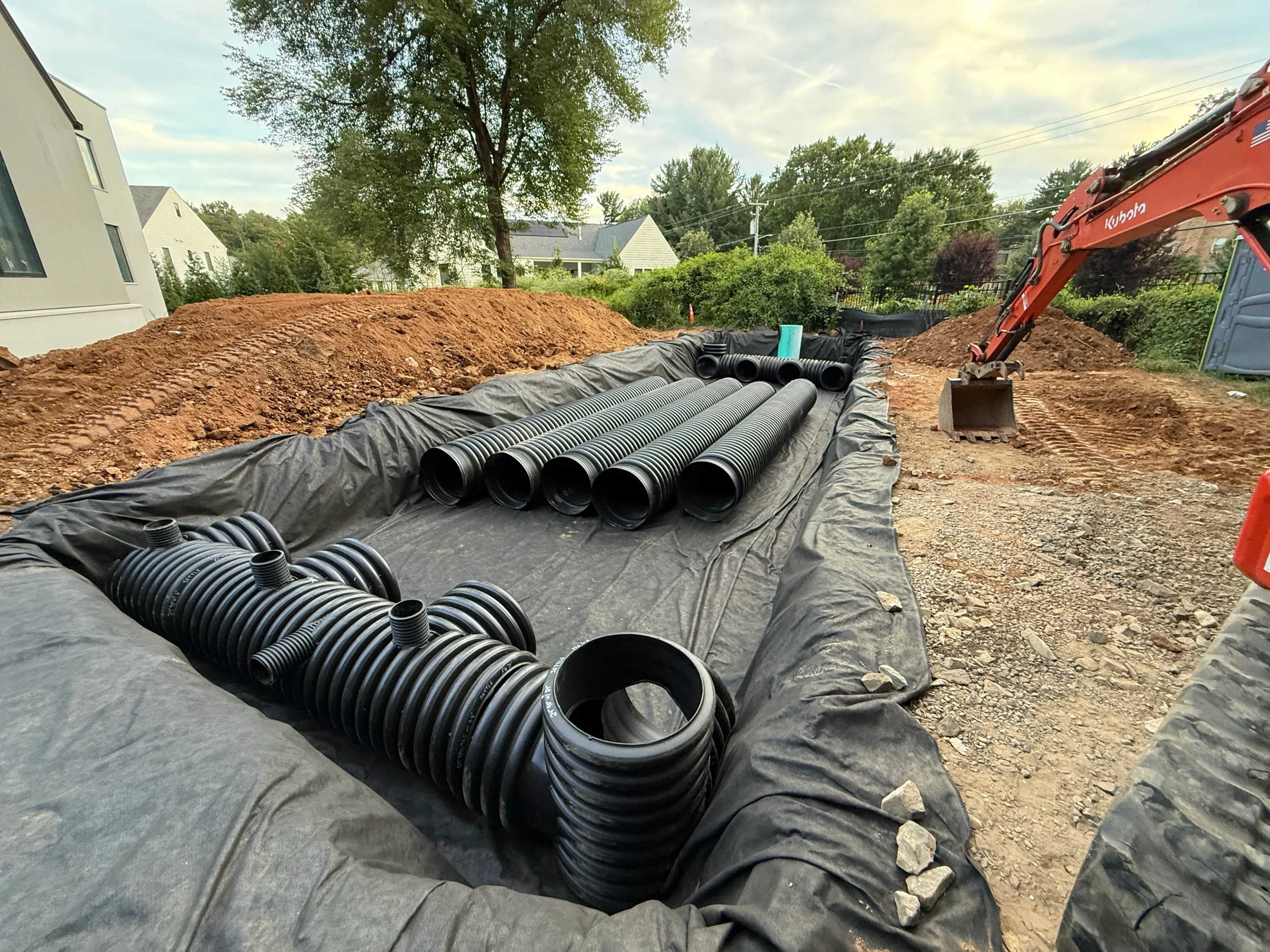
We install large-diameter HDPE pipe detention systems, StormTech modular chamber systems, and related inlet and outlet structures. System selection is typically determined by the engineer of record based on site conditions, storage volume requirements, available depth, and loading conditions. We install to approved civil plans and manufacturer requirements.
-
An underground detention system captures and stores stormwater runoff below grade in a network of pipes, chambers, or vaults. Stored water is released at a controlled, pre-approved rate through an outlet control structure, reducing peak flows, preventing downstream flooding and helping projects meet local stormwater quantity requirements. These systems are commonly installed beneath parking lots, access roads and developed sites where surface storage is not practical.
-
A detention system captures and temporarily stores stormwater runoff and releases it at a controlled rate water does not permanently remain in the system. A retention system, such as a wet pond, permanently retains a pool of water and provides additional storage capacity above the permanent pool for storm events. Both system types require regular inspection and maintenance to perform as designed.
-
With proper installation and consistent maintenance, most stormwater BMPs are designed to perform for decades. Underground detention pipe and chamber systems can have service lives of 50 years or more when properly installed and maintained. Bioretention systems and wet ponds require more active ongoing maintenance but can perform indefinitely with proper care. Neglected systems deteriorate significantly faster and may require costly rehabilitation or reconstruction.
-
Stormwater systems are designed by the engineer of record typically a licensed civil engineer as part of the site development plan. The engineer determines system type, sizing, layout, outlet control design and BMP selection based on site conditions, local stormwater requirements and Virginia DEQ design standards. Capital Stormwater Services installs to approved civil plans and coordinates directly with the engineer of record and general contractor throughout the installation process.
-
Yes, that is exactly how we work. We review PE-stamped civil plans, coordinate with the engineer of record and general contractor, verify field conditions against plan dimensions and install systems to specification. We do not design systems, but we are experienced in reading and executing complex stormwater plans accurately and efficiently.
BMP MAINTENANCE & INSPECTION
-
BMP stands for Best Management Practice a stormwater control measure designed to manage runoff quantity, improve water quality or both. Common BMPs include bioretention cells, rain gardens, dry swales, infiltration trenches, wet ponds, and underground detention systems. If your property was developed or redeveloped after Virginia's stormwater regulations took effect, it likely has one or more BMPs that are required to be maintained under a recorded maintenance agreement.
-
Yes. In Northern Virginia, privately owned BMP facilities are subject to recorded maintenance agreements that require regular inspection, maintenance and documentation. These obligations run with the property and are enforceable by local stormwater authorities. Failure to maintain your BMP can result in inspection findings, notices of violation and mandatory corrective actions.
-
Inspection and maintenance frequency varies by BMP type, local jurisdiction and the terms of your recorded maintenance agreement. Most jurisdictions in Northern Virginia require annual inspections at minimum. Some facilities require more frequent maintenance depending on drainage area, sediment loading and system type. Capital Stormwater Services reviews your maintenance agreement and establishes a maintenance schedule tailored to your facility and local requirements.
-
Your recorded plat, deed of dedication, stormwater maintenance agreement or approved site plan should identify the type, location and design specifications of any BMP facilities on your property. If you are unsure, Capital Stormwater Services can conduct a site visit, review available records and identify your facility type, applicable maintenance requirements and current condition.
-
Our inspection reports document facility identification and BMP type, sediment accumulation levels, outlet structure condition, embankment and slope stability, inlet and conveyance conditions, access conditions, identified maintenance concerns, priority-ranked maintenance recommendations and comprehensive field photography. Reports are prepared for owner, property manager and county compliance records.
-
Stormwater BMP maintenance obligations are typically recorded in a deed of dedication, easement or maintenance agreement that runs with the property meaning they transfer to the new owner at closing. Buyers should review stormwater maintenance agreements during due diligence. Sellers should ensure maintenance records are current and available for transfer. Capital Stormwater Services can conduct a pre-sale or pre-purchase facility inspection and provide a documented condition report.
-
A forebay is a small settling basin at the inlet of a wet pond, bioretention cell or detention facility designed to capture coarse sediment before it reaches the main treatment area. Forebays fill with sediment over time and require periodic cleanout to maintain their design storage volume and protect the performance of the primary facility. Most Virginia design standards recommend forebay cleanout when sediment reaches 50% of design volume.
-
Sediment accumulation thresholds vary by BMP type and local design standards. For forebays, most Virginia design standards require cleanout when sediment reaches 50% of the forebay's design storage volume. For bioretention media surfaces and underground vaults, any significant accumulation that reduces infiltration or storage capacity warrants attention. Our inspection reports identify accumulation levels and recommend cleanout when thresholds are approaching or exceeded.
-
In most cases, yes. Outlet structures, risers, trash racks, orifice plates, inlet pipes, erosion damage, and embankment issues can typically be repaired or replaced without full system reconstruction. Early identification of developing problems through regular inspection is the most cost-effective way to keep repair scopes manageable. Capital Stormwater Services assesses facility conditions, identifies repair needs and performs targeted repairs to restore function and compliance without unnecessary cost.
-
Yes. Capital Stormwater Services works with HOAs and property management companies throughout Northern Virginia to establish scheduled maintenance programs for community stormwater facilities. We conduct annual or semi-annual inspections, perform required maintenance and provide documented reports that satisfy local maintenance agreement obligations and give HOA boards and property managers the records they need for community compliance and liability protection.
-
A stormwater facility that is not maintained to design capacity can contribute to downstream flooding, erosion and property damage. Property owners who fail to maintain their stormwater facilities in accordance with recorded maintenance agreements may face civil liability exposure in addition to regulatory consequences. Documented, scheduled maintenance is one of the most straightforward ways to demonstrate responsible facility stewardship.
-
Contact us as soon as possible. County stormwater inspection notices typically require a response and corrective action within a defined timeframe. Capital Stormwater Services can conduct an immediate facility assessment, identify what maintenance or repairs are needed, perform the work and provide the documentation you need to respond to the county and demonstrate that your facility has been brought back into compliance.
-
Common indicators of reduced bioretention performance include standing water that does not drain within 24 to 48 hours after a storm event, visible sediment accumulation on the media surface, bare or dying vegetation, erosion at the inlet, blocked or damaged overflow structures and visible bypassing of runoff around the facility. If you observe any of these conditions, a maintenance inspection is warranted. Capital Stormwater Services can assess your facility and recommend the appropriate corrective measures.
WORKING WITH CAPITAL STORMWATER SERVICES
-
Capital Stormwater Services serves Northern Virginia's six-county market, Fairfax, Loudoun, Prince William, Arlington, Fauquier and Culpeper counties. Our focused service area allows us to mobilize quickly, maintain strong familiarity with each jurisdiction's stormwater program and provide responsive service to our clients throughout the region.
-
Contact us through our website contact form, by phone or by email. Share your project details, site location and any available plans or documents. A member of our team will review your information and follow up promptly with a detailed proposal.
-
No. Critical stormwater installation and maintenance work is self-performed by our in-house crew. Our foreman and crew handle excavation, installation, maintenance, and inspection directly which means greater quality control, clearer accountability, and no coordination delays associated with subcontracted work.
-
Project costs vary based on system type, site conditions, facility size, scope of services and local requirements. We provide free project consultations and detailed written quotes. Contact us with your project information and we will respond promptly with a specific proposal tailored to your needs.
-
We prioritize emergency response for active facility failures, post-storm damage and time-sensitive compliance situations. Contact us directly by phone for the fastest response. We will assess the situation, advise you on immediate stabilization steps if needed and mobilize our crew and equipment as quickly as conditions allow.
-
The more detail you can share upfront, the faster we can respond with accurate information. Helpful information includes your property address or project location, BMP type or system description if known, a description of the issue or scope of work needed any available civil plans, inspection reports or maintenance agreement documents and your timeline or any compliance deadlines you are working toward. You can attach documents directly through our website contact form.